
Great to see The Wall Street Journal highlighting the evolution of self-storage, and an honor to be a part of it.
The industry is at an inflection point — strong demand continues, but communities are thinking more critically about where and how storage fits.
One thing hasn’t changed: customers want convenience. Accessible, well-located facilities matter.
That’s why today’s focus is on better design, smarter placement, and being a good neighbor.
Important conversation for the future of our industry.
Read the full article below:
Local communities are fighting back against sprawling storage centers, even as owners try to make them better neighbors
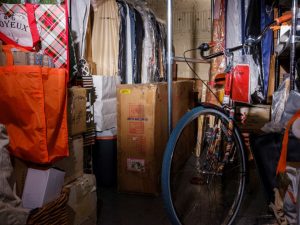
In Sara Vass’s storage space even the bicycle is fashionable: Its trim was part of a limited edition by Missoni. Michael Bucher/
By Fred A. Bernstein
April 15, 2026 5:30 am ET
Sara Vass, a marketing executive, calls herself “the queen of storage spaces.” She has one cramped unit not far from her Lower Manhattan apartment, and another on the East End of Long Island, where she used to own a house. She inherited three more units in Queens from her mother, the fashion designer Joan Vass, which she spent years consolidating. The Manhattan space alone costs as much as an apartment, she says, and it isn’t air-conditioned. That means she needs loads of “moth pucks.”
“If you’re going to keep an original Alexander McQueen,” she says wisely, “you don’t want it eaten by moths.” Then too, she has her mother’s ashes in storage, next to a vintage Pee-wee Herman doll in its original packaging. The storage spaces, she says, “are the bane of my existence.” But, Vass says, they contain happy memories.
Can she afford to give those up?
Many Americans are asking themselves similar questions.

Vass keeps overflowing belongings in a storage unit in Lower Manhattan. Michael Bucher/WSJ
More than 12 percent of American households stash their overflow in rented storage spaces, according to Noah Starr, founder and CEO of TractIQ, a leading market data provider. “There has never been a period with more people using self storage than today,” Starr adds. Meanwhile, the industry is developing another 164 million square feet of self-storage, according to TractIQ.
But in some local government and urban planning circles, the windowless establishments are seen as hogging land and creating dead zones where there ought be street life. This is especially true now that the kind of storage facilities that 30 years ago were mom and pop operations, with mom and pop living on the premises, are managed remotely by large corporations. Technology, and industry consolidation, mean many facilities are now run out of distant control rooms.
That leaves some towns feeling ghosted. Since 2019, bans on self-storage facilities have been enacted in parts of at least 15 states, from Maine to California, according to the industry website Modern Storage Media. Denver, Colo., prohibits self-storage facilities near light-rail stations, where officials are hoping for new housing, while Providence, R.I., instituted a city-wide moratorium in 2023.
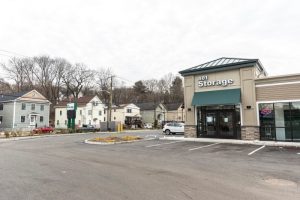
A self-storage facility was built across the street from homes in the Manton neighborhood in Providence, R.I. Julie Bidwell for WSJ
Miguel Sanchez, the Providence city council member who pushed for the ban, says that storage facilities are taking up “a lot of land that should be used for other purposes.” Sanchez was particularly incensed when an 11-acre plot in the city’s Manton neighborhood, on a largely residential street, became a single-story self-storage facility with long rows of garage doors. Enacting the ban in Providence, he says, was easy: the city already prohibits the building of prisons, incinerators and slaughterhouses. “We just added self-storage to the list.”
He wishes he could solve the underlying problem: “People buy stuff they don’t really need and then hold onto it,” he says. Meanwhile, 20 miles away, in Bristol, the facade of a new storage facility was designed to resemble a row of old houses. But the false front isn’t fooling anyone.
Delta Township, Mich., a suburb of Lansing, is using zoning to keep storage facilities off its main thoroughfares. “We’re just trying to be more mindful of our commercial corridors, where jobs can be created

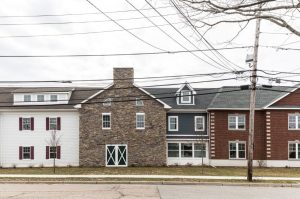
A self-storage facility in Bristol, R.I. was disguised as a row of houses. Julie Bidwell for WSJ
But customers “don’t want to drive out to some industrial park,” says Maurice Pogoda, whose Farmington, Mich.-based National Storage Management Co. owns or operates 72 facilities in the Midwest. “They want to be on a main road, somewhere convenient and visible.”
As for the perception that storage facilities are eyesores? Today’s self-storage facilities, Pogoda says, “can compete with some of the best-designed buildings out there.”
In fact, architectural triumphs in the self-storage sector are elusive. But it is true that owners are trying to create facilities that don’t look out of place. Allen Farnsworth, the general manager of SoCal Self Storage, operates one facility in Pasadena with a laundromat on-site and another in Hollywood that houses a Thai restaurant. Those commercial spaces were included in part to speed approvals. “Mixed use is generally better received by city councils than storage alone,” Farnsworth says.
And then there’s Stuf Storage, a start-up that inserts storage spaces into existing, and often very handsome, buildings. One of its Los Angeles facilities is inside the SAG-Aftra building, a 1949 International Style landmark on Wilshire Boulevard. There, the company has carved 200 units out of 17,000 square feet, according to Stuf founder Katharine Lau. That’s a fraction of the size of most “big box” operations. Consequently, Stuf has relatively few large units, which reduces the number of “sticky” customers—people who move in but don’t move out. “One thing we’ve consistently found is that the larger the unit, the longer the customer stays,” says Lau.

Maurice Pogoda’s National Storage location in Southfield, Mich., has won awards.
Stuf’s business model means it doesn’t put up new buildings with blank facades, but neither does it bring new life to existing commercial strips. The company’s locations “run on our proprietary software and are backed by a small team of floating field technicians,” says Lau. “Essentially, we’ve turned overlooked spaces in residential and commercial buildings into a fully automated storage business.” She is optimistic about 2026. “We’re operating in dense cities where new supply is structurally limited,” she says, and with automation, she believes, Stuf can scale up quickly as demand increases.
Timothy Dietz, president of the Self Storage Association, a national trade group, agrees that owners in what he says is a $60 billion industry are putting more thought, and more money, into design. “The industry was created 60 or 70 years ago with chicken wire and cinder blocks,” he says. Now it’s about state-of-the-art construction, convenience and customer service.”
What drives customers to storage, Dietz says are the four D’s: downsizing, decluttering, divorce and death.
But the biggest factor may be another D: disease. In 2020, demand for self-storage spiked as the pandemic caused millions of Americans to relocate or convert basements and garages into living quarters or home offices. Since then, occupancy has slipped considerably as a percentage of available square footage. The industry’s fortunes, for the most part, follow those of the real-estate market, and the real-estate market has been sluggish. But Starr says the data from REITs, which control about 30 percent of the industry and are subject to quarterly reporting requirements, shows occupancy increasing for the first time, year-to-year, since 2021.
One thing that hasn’t dropped much is the cost—at least for existing customers. New customers are often enticed with introductory prices (known in the business as the street price) that are far lower than the same owner gets from existing tenants (called the achieved price). REIT data suggests operators are keeping existing customers at relatively high rates with low delinquency, but slower home mobility has reduced new customer demand, according to Starr. That forces companies to compete with low advertised rates.
Nationally, the average advertised price for a 10-by 10-foot space is about $125 without climate control and about $150 with, although in major East and West coast cities the tab can be more than double that. But the achieved price for the same units is higher. According to TractIQ’s REIT data, the average gap between street price and achieved price in the last three months of 2025 was 18.9 percent.
When Sara Vass called her storage facility this week and asked how much an 8-by-15-foot unit like hers would cost a friend who needed one, she was given a price 20% lower than what she has been paying.